More impact from every euro invested
PD Guest Article
In 2024, the municipal investment backlog reached a new record of 215.7 billion euros. At the same time, the federal and state governments are more determined than ever to invest, including via the infrastructure special fund. The real challenge therefore does not lie in financing, but in strategic implementation: How can administrations translate these funds into concrete improvements for schools, mobility, the climate and public services?
Record shortfalls despite special funds: Why allocated investment resources do not automatically have an impact
In March 2025, the Bundestag and Bundesrat adopted the Special Fund for Infrastructure and Climate Neutrality (SVIK) with a volume of 500 billion euros. This makes the initiative the largest investment drive in the history of the Federal Republic. 300 billion euros will go into the federal budget, 100 billion euros will flow into climate investments via the Climate and Transformation Fund, and 100 billion euros will be made available directly for municipal infrastructure through the states' pillar.
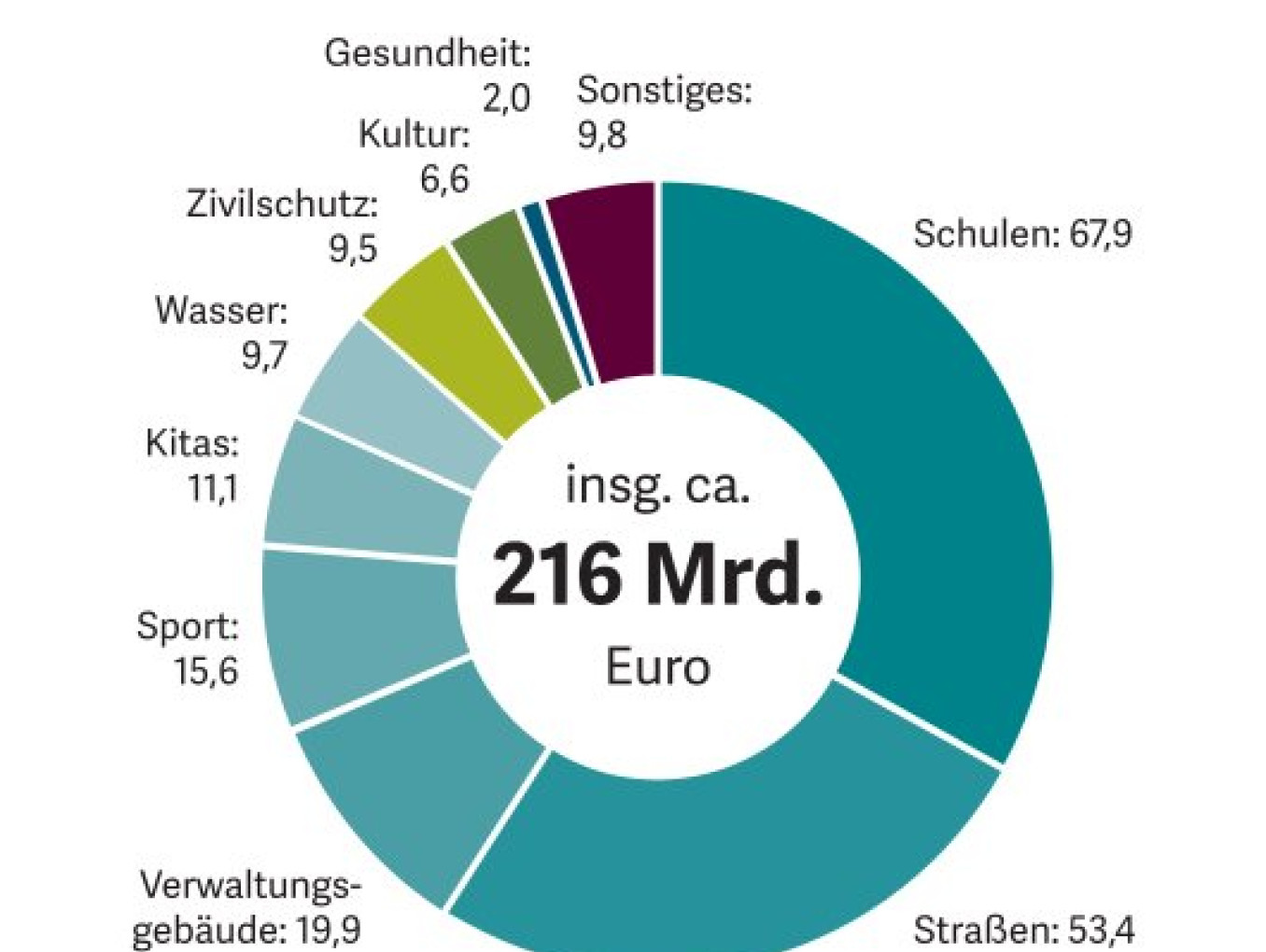
Yet the investment backlog continues to grow. The KfW Municipal Panel 2025 shows that Germany’s municipalities put their investment backlog for 2024 at 215.7 billion euros. This corresponds to an increase of 15.9 percent compared to the previous year. The largest share is attributable to dilapidated school buildings (67.8 billion euros), followed by road and transport infrastructure (53.4 billion euros). Especially pressing: As of the 2026/27 school year, the legal entitlement to all‑day care for primary school children will be introduced step by step, starting with first grades. In many places, however, the necessary building infrastructure is still lacking.
Yet the investment backlog continues to grow. The KfW Municipal Panel 2025 shows that Germany’s municipalities put their investment backlog for 2024 at 215.7 billion euros. This corresponds to an increase of 15.9 percent compared to the previous year. The largest share is attributable to dilapidated school buildings (67.8 billion euros), followed by road and transport infrastructure (53.4 billion euros). Especially pressing: As of the 2026/27 school year, the legal entitlement to all‑day care for primary school children will be introduced step by step, starting with first grades. In many places, however, the necessary building infrastructure is still lacking.
The paradox is measurable: Municipalities planned investments of 47 billion euros for 2024 but actually spent only 30 billion euros. For 2025, 48 billion euros were planned, with the actual figure not yet published. The gap between planning and reality is not due to a lack of political will. It is caused by structural obstacles: insufficient staff in construction departments, complex documentation requirements and lengthy approval procedures. The decisive question is therefore not how to mobilise even more money, but how administrations can remain capable of acting, set priorities and systematically build implementation capacity.
The forecast of the Central Association of the German Construction Industry underscores this dilemma. Municipalities are being promised 60 billion euros from the SVIK. Nevertheless, the leading municipal associations expect that investments will fall to around 31 billion euros by 2028 and that the accumulated investment backlog will largely remain.
At state level, ambitions are gaining momentum. Lower Saxony, for example, is mobilising almost 14.5 billion euros in additional investments in education and healthcare, housing construction, climate action and digitalisation under the “Lower Saxony Can Shape the Future” programme as part of the 2026 budget. North Rhine‑Westphalia, Bavaria and Baden‑Württemberg are pursuing similar approaches. This raises a central question of modern public administration: How can investments be organised so that political commitments turn into effective, scalable and sustainable solutions?
From planning to impact: What strengthens public administrations in practice
The special fund and additional investments in the core budget alone do not solve the problem. Funding needs to be accessed, projects prioritised and initiatives implemented in ways that safeguard the administration’s ability to act. To do this, municipalities, states and the federal government need not only financing, but also structures, tools and partners that enable implementation and support learning across federal levels.
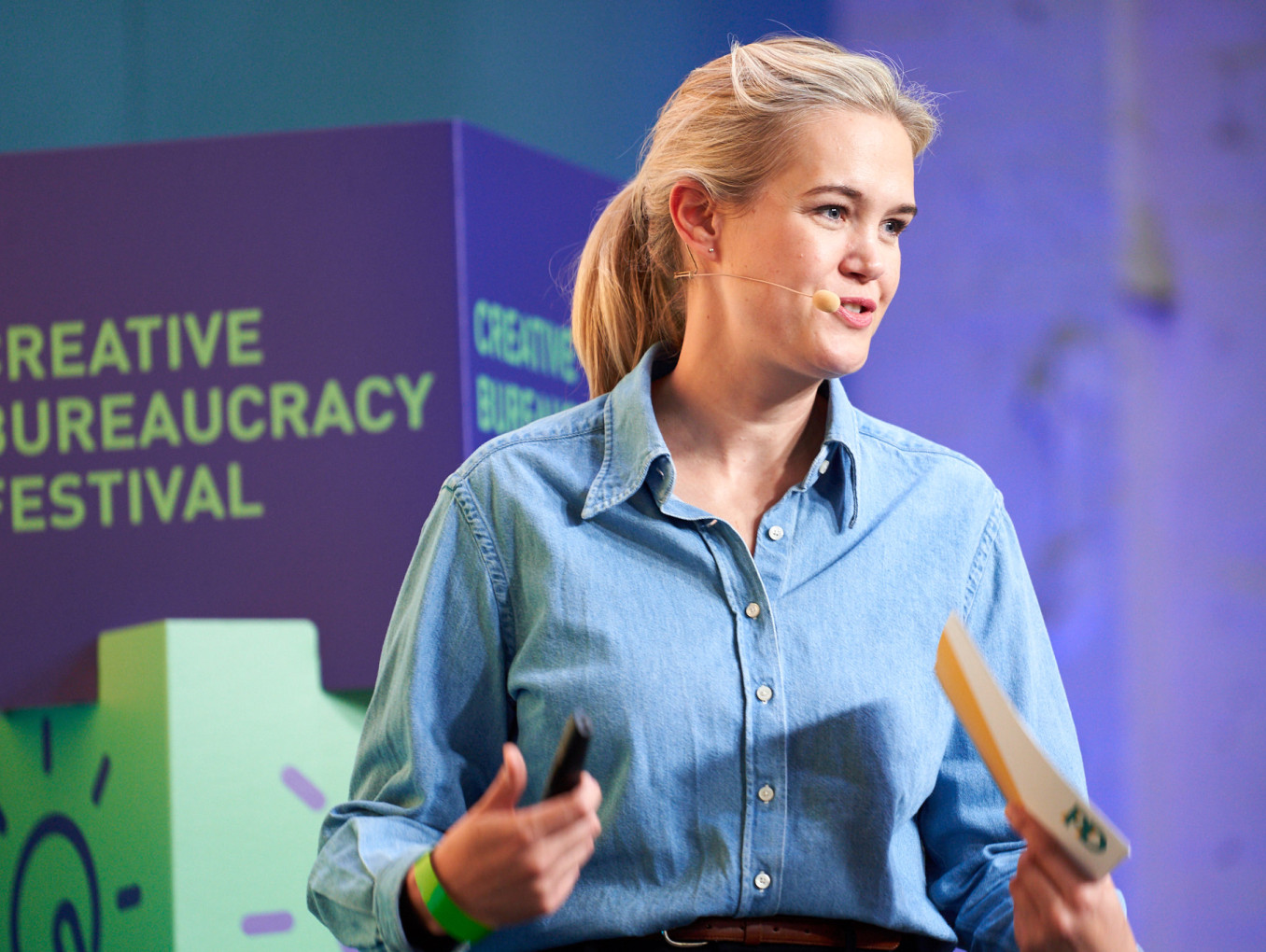
As an in‑house consultancy, PD – Berater der öffentlichen Hand GmbH – supports municipalities, states, the federal government and other public organisations in turning investments into reality, from the first idea through to implementation. These hands‑on experiences make PD a strong partner of the Creative Bureaucracy Festival. There, we showcase which approaches can be transferred to other administrations and scaled more broadly.
What these approaches look like in practice is illustrated by three examples from projects in which PD and its clients have jointly planned and implemented investment initiatives.
Ensuring value for money from the outset
An effective approach starts long before the first ground is broken. Public clients need to clarify at an early stage which procurement option is economically and financially viable in the long term – for example in‑house delivery, renting, PPP or leasing. With the WU Model 3.0, which PD developed on behalf of the Federal Ministry of Finance (BMF), public decision‑makers have access to a free calculation tool that allows them to systematically compare different delivery options for building projects.
This makes decisions data‑driven, comparable and more transparent. Administrations gain confidence in managing complex investments effectively. At the Creative Bureaucracy Festival, we present these practical tools on stage to make investment decisions easier. Where in‑house capacity is lacking, it can also be helpful to draw on operational support for value‑for‑money analyses and business case calculations.
Unlocking funding strategically
Many municipalities leave substantial funding potential untapped – not due to a lack of interest, but because the landscape of EU, federal and state programmes is hard to navigate. On behalf of the Federal Ministry of Health, PD set up and operated the national contact point for the EU funding programme EU4Health. With a volume of 5.3 billion euros, EU4Health is the largest health programme in the history of the European Union. German healthcare institutions, municipalities and NGOs received support throughout all phases of their funding applications.
We apply this comprehensive approach to all major funding programmes: Under the German Recovery and Resilience Plan (DARP), for example, PD is working on behalf of the BMF to make funding programmes for municipal administrations more transparent and easier to use through tailored advisory services, concise guidance documents and open workshops – helping to mitigate the social and economic impacts of the COVID‑19 pandemic.
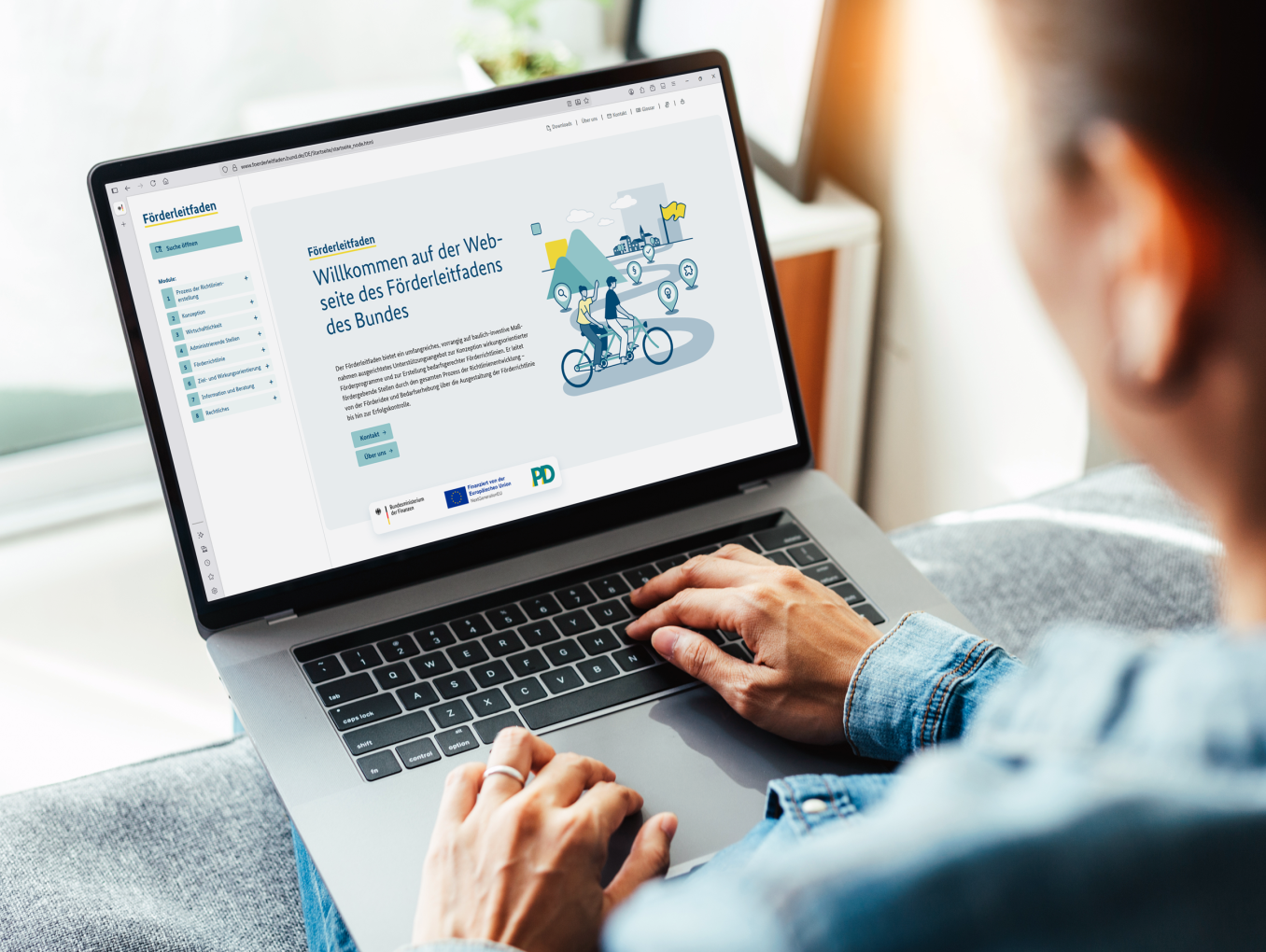
This shows what many visitors to the Creative Bureaucracy Festival care about: Impact emerges where knowledge is accessible, barriers are reduced and good procedures do not remain isolated, but can be adopted by other administrations. At federal level, the Funding Guidelines Toolkit already supports authorities in designing funding regulations by providing modular templates and wording support. This puts a central aspect of public sector innovation in the spotlight: The crucial point is not only to implement individual projects, but also to improve the overall framework so that public funds reach practice more easily, clearly and in line with actual needs.
Building sustainably, saving in the long term
Public investments in buildings need to be economical today and remain so over their entire life cycle. Buildings account for around one third of CO₂ emissions in Germany when direct operational emissions, indirect emissions from electricity and district heating, and embodied emissions from construction materials are taken into account. Our consultants with recognised expertise in sustainable construction and operation support municipalities in anchoring their sustainability objectives from the earliest project phases – from refurbishment and decarbonisation strategies for building portfolios to integrating climate targets into public procurement processes.
These examples show how PD turns investments into tangible results. We do not produce concepts that end up in a drawer; instead, we support authorities and administrations from idea to implementation. We see ourselves as a thought leader for the public sector, working in partnership and bringing real‑world experience to the table. This enables public resources to reach where they are most needed – and allows individual projects to evolve into approaches that other administrations can also use for their transformation agendas.
At the Creative Bureaucracy Festival, we share these experiences with our community so that public administrations can learn from one another and embed sustainable investment practices more broadly in everyday work.
Act now: Meet PD at the Creative Bureaucracy Festival 2026
Germany’s investment drive has finally begun with the adoption of the special fund for infrastructure and climate neutrality. Initial signs of an upswing in investment are already being reported from the construction industry, even if not across all sectors.
The question is therefore no longer whether, but how the money will be used effectively. The answers – and the people putting them into practice – will come together at the Creative Bureaucracy Festival in Berlin on 11 June 2026.
For PD, the Creative Bureaucracy Festival is Europe’s most important platform for public innovation and administrative modernisation. It is where public administration meets new ideas, proven solutions and partners who make the difference between planning and impact.
As a main partner of the festival, PD will be contributing several sessions, including on pedagogical cloud infrastructure, investments under the DARP and digital sovereignty.
Use 11 June to meet and talk with our consultants. Bring your concrete projects, challenges, ideas and questions – we look forward to seeing you.