Organization in Uncertain Worlds: Report from the 26th Conference on Organization Studies
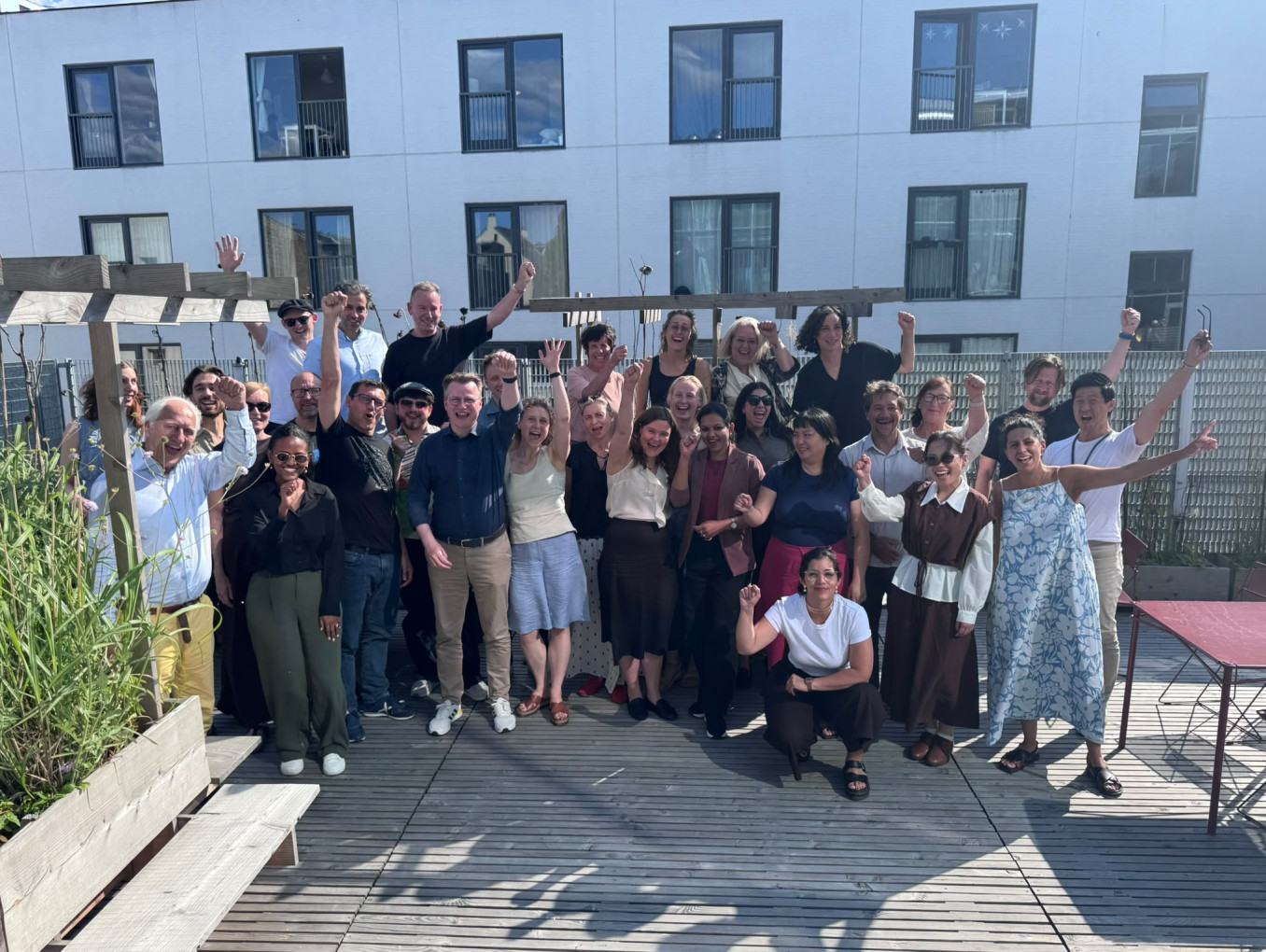
Upon entering Thoravej 29, nestled in Copenhagen’s bustling Nordvest district, one cannot fail to notice its rawness. Exposed pipes and walls, concrete and steel set upon an uneven flooring are interspersed with couches, coffee counters, and sustainable furniture. The former municipal building that now houses hundreds of creative minds communicates openness, not just architectural experimentality but also conceptual curiosity and organizational flexibility. The building rehearses new ideas and alternative ways of forming communities of practice.
Gathering Around Uncertainty
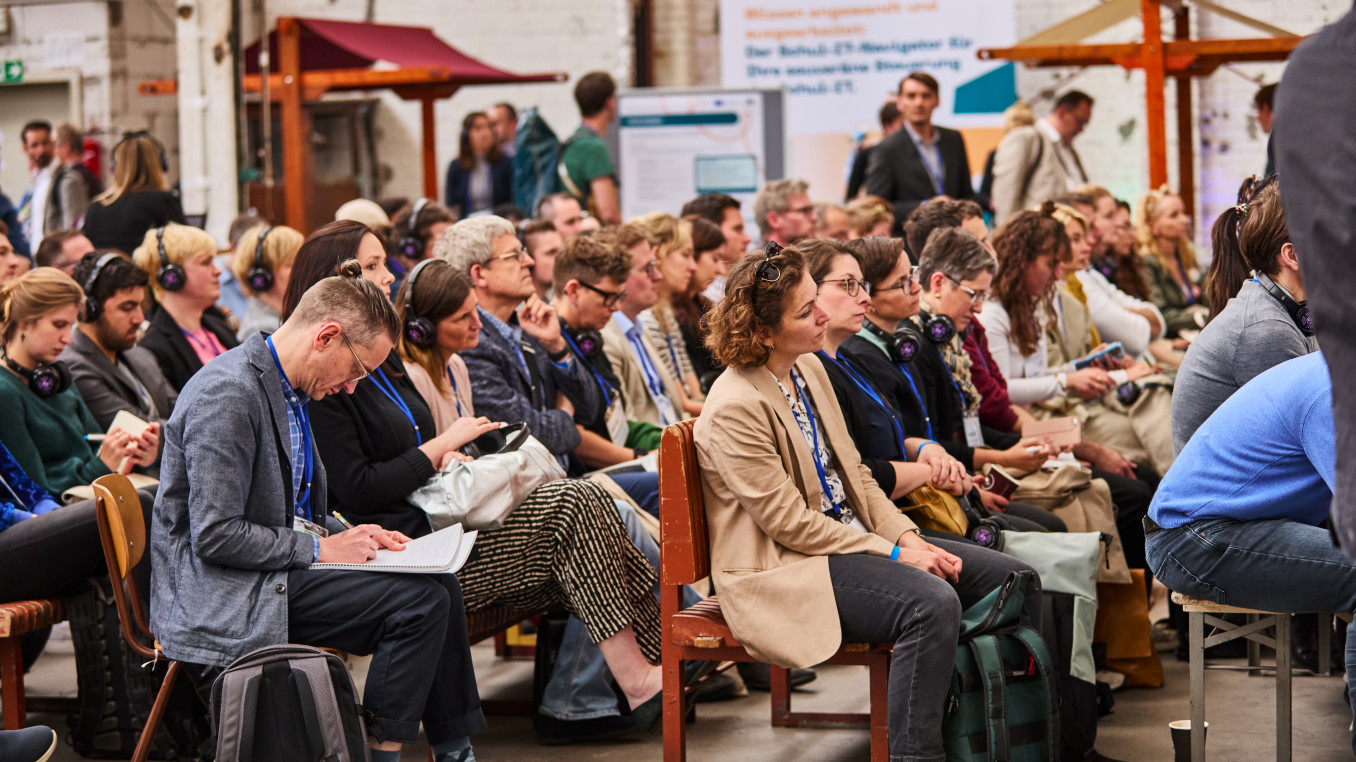
This unique setting served as the venue for the 26th conference on organization studies, on the topic of Organization in Uncertain Worlds. In late June 2026, dozens of creative minds joined network chairs Charles Landry and Anke Gruendel to discuss new intersections between organizational thought, public sector practice, and local organizing, in a new direction for the research network, which is part of the Common Ground group. Local host Christian Bason—whose work at the Danish government innovation Lab MindLab, the Danish Design Center, and now Transition Collective is key to rethinking organization in times of uncertainty—opened the intense two day conference by welcoming a diverse crowd. Attendees hailed not only from across the globe but also from many different disciplines and professions, including people working in practical fields such as banking, railroads, government, the health sector, or defense.
A Space Built for Experimentation
But Thoravej 29 is more than an address or an event space. It’s an organization itself, as Søren Kaare-Andersen, CEO of Bikuben Foundation—the organization that initiated the Thoravej 29 experiment—explained during the opening address. Less a rigid organizational structure and more a community, Thoravej 29 brings together close to 200 people hailing from 39 organizations working with art, social innovation, sustainability, democracy, digital innovation, and politics who all share the same mission to create positive change.
A Space Built for Experimentation
But Thoravej 29 is more than an address or an event space. It’s an organization itself, as Søren Kaare-Andersen, CEO of Bikuben Foundation—the organization that initiated the Thoravej 29 experiment—explained during the opening address. Less a rigid organizational structure and more a community, Thoravej 29 brings together close to 200 people hailing from 39 organizations working with art, social innovation, sustainability, democracy, digital innovation, and politics who all share the same mission to create positive change.
Rethinking Mission-Driven Organizations
Kaare-Andersen, a former banking executive who left the field to channel his talents towards more sustainable goals, explained that Bikuben’s mission-based approach to bringing about radical societal, political, and ecological transformation means delegating some of the decision power to the members of the community rather than concentrating it at the top. In other words, the building as much as the organization that initiated this architectural and organizational transformation, has to answer the question: what is the proper organizational form for a mission orientation? After all, missions are useful for focusing on a specific problem but also contain possible pitfalls when they fail to adapt to the turbulent political, social and economic environment in which organizations have to function.
From Crisis to Turbulence
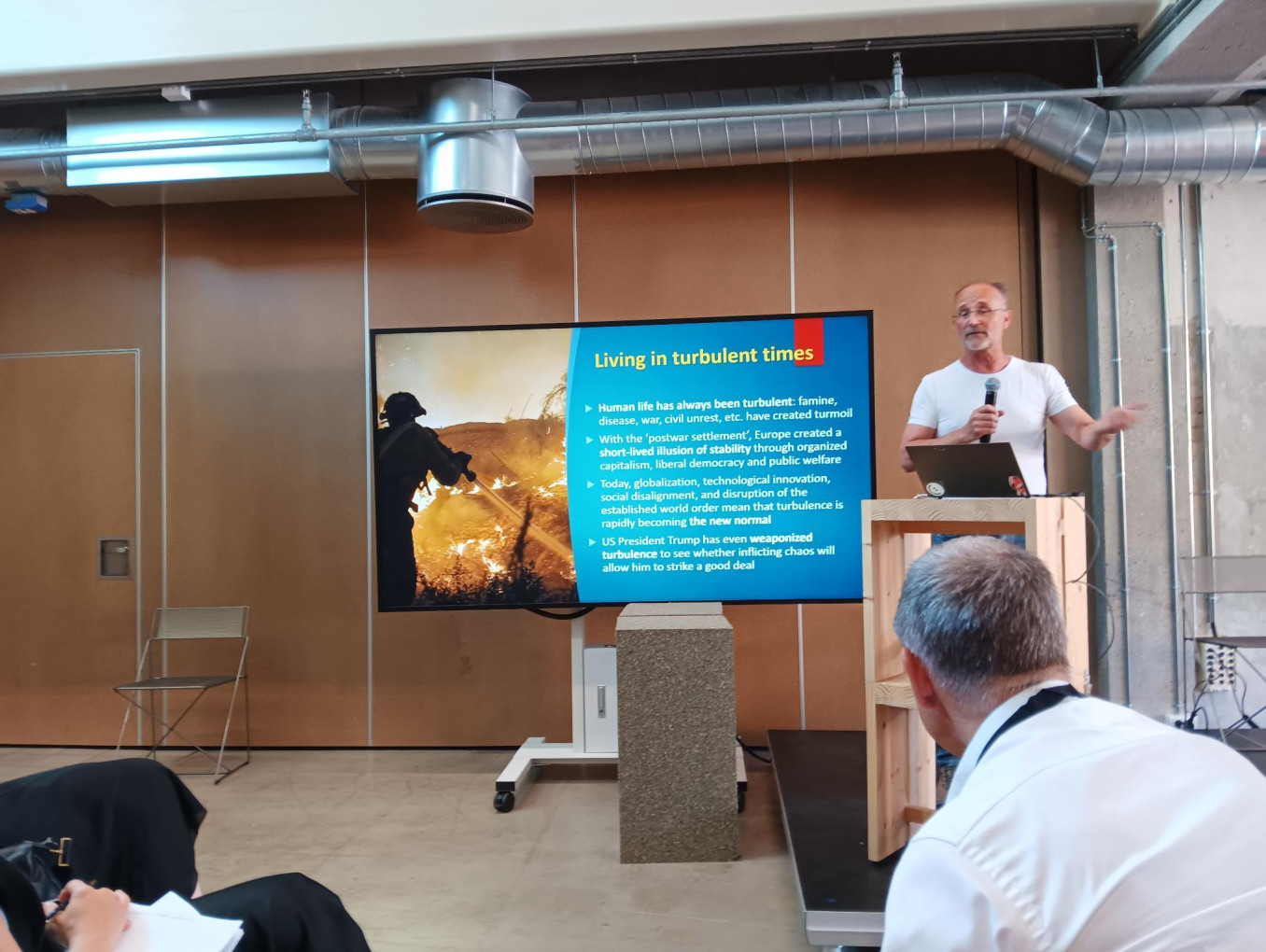
This question of turbulence emerged as a central tenet of the conference after Jakob Torfing, professor of political sciences at Roskilde University, who was joined by Sara Gry Striegler, founder of Kindred Lab, in the evening keynote, described an analytical shift away from the notion of crisis. As Torfing explained, turbulence offers a more appropriate analysis for our current moment which is so often described via the moniker polycrisis, where multiple crises compound each other and become a permanent substrate of governance. In contrast to crises which punctuate and disrupt periods of assumed stability, turbulence acknowledges that even if rupture occurs, it is usually preceded and followed by longer periods of instability (or turbulence) in which making meaningful predictions or decisions based on past data is uniquely fraught.
Designing for an Uncertain Future
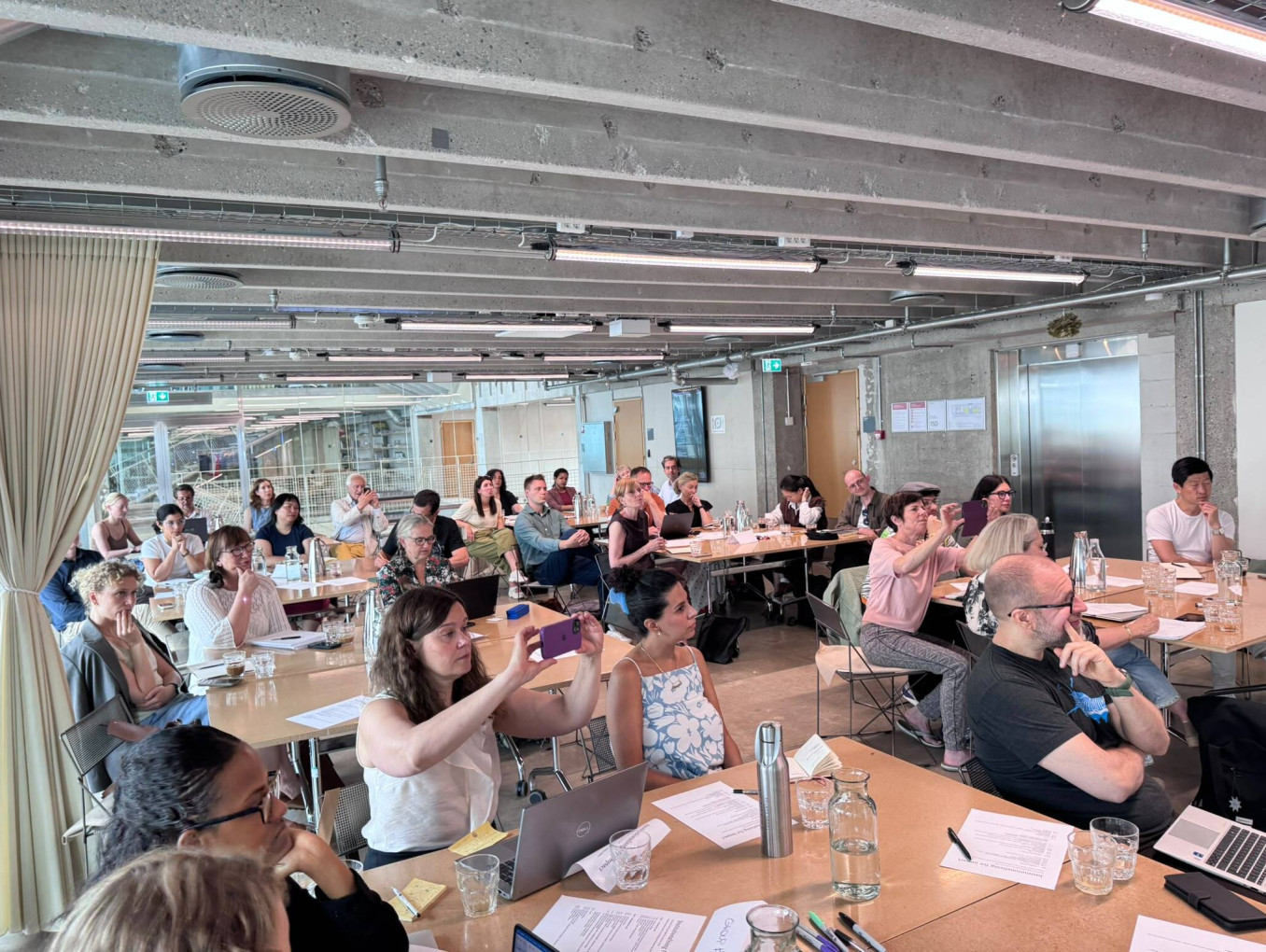
Acknowledging that we are entering—or are already in the midst of—a period of turbulence means moving away from modes of crisis governance and towards a more long-term model or robust governance of turbulence in which legacy organizational forms have to be rethought. Gry Striegler picked up on the problem of futures embedded in the analysis of turbulence, arguing that we cannot navigate uncertainty with prediction alone. Building on design as a practice that does more than produce beautiful and useful products, she asked: what if the organization becomes the experiment?
Designing for an Uncertain Future
Acknowledging that we are entering—or are already in the midst of—a period of turbulence means moving away from modes of crisis governance and towards a more long-term model or robust governance of turbulence in which legacy organizational forms have to be rethought. Gry Striegler picked up on the problem of futures embedded in the analysis of turbulence, arguing that we cannot navigate uncertainty with prediction alone. Building on design as a practice that does more than produce beautiful and useful products, she asked: what if the organization becomes the experiment?
Design, she insisted, creates alternative temporalities for institutional learning, creating the possibility of what Torfing called robust governance, a process which adapts to changing circumstances rather than returning to a prior stable state after a crisis. But such a shift entails rethinking what learning is: moving away from treating learning as a process of information transfer in favor of understanding it as a social and situated practice.
Innovation from the Frontlines
Indeed, turbulence is not an entirely new framework but it has been a social reality in many parts of the world, as Laura Nkula-Wenz (African Centre for Cities) and Gabriella Gomez-Mont reminded the audience. Nkula-Wenz argued that for most African city dwellers under conditions of turbulence, innovation is not a luxury but an imperative. Where municipal leadership turns to design practice to do more with less it creates mutable intersections of people and places, where reimagining institutions means embracing genuine transformation rather than merely stretching but ultimately conforming to rigid organizational norms. Thus, a more relational approach in which bureaucratic activists are empowered to change the institution from within—together with the people they are meant to serve—is legion in turbulent times. Gomez-Mont (UCL Institute for Innovation and Public Purpose) reflected on her experience as the director of the Mexico City-based Laboratorio Para La Ciudad and offered insights on how precarious innovation initiatives nonetheless can become permanent fixtures of government. Although the Lab fell victim to the whims of political leadership, her work in the CDMX government produced a crowd-sourced constitution for a city of 10 million people and demonstrated that social innovation can become translated into constitutional law.
Carrying the Conversation Forward
Finally, Geoff Mulgan, Professor of Collective Intelligence, Public Policy and Social Innovation at UCL and founder of The Institutional Architecture Lab, showed how new organizational thinking (e.g., stack thinking) can produce a plethora of new institutional forms that may be more appropriate for turbulent times. Organizational design, then, requires both building a new field and community of practice which brings together academics and practitioners and collaborations or unexpected partnerships.
It is this collaborative, creative space, this new field, that the conference, the venue, and the presentations contributed to. Such a vibrant space in which new ideas about public sector innovation are allowed to percolate must remain the gilding principle of thinking organization in uncertain worlds. It is this dynamic that we want to carry forward into next year’s conference in Berlin. Join us!
Published: 12 August 2026
ABOUT THE AUTHOR
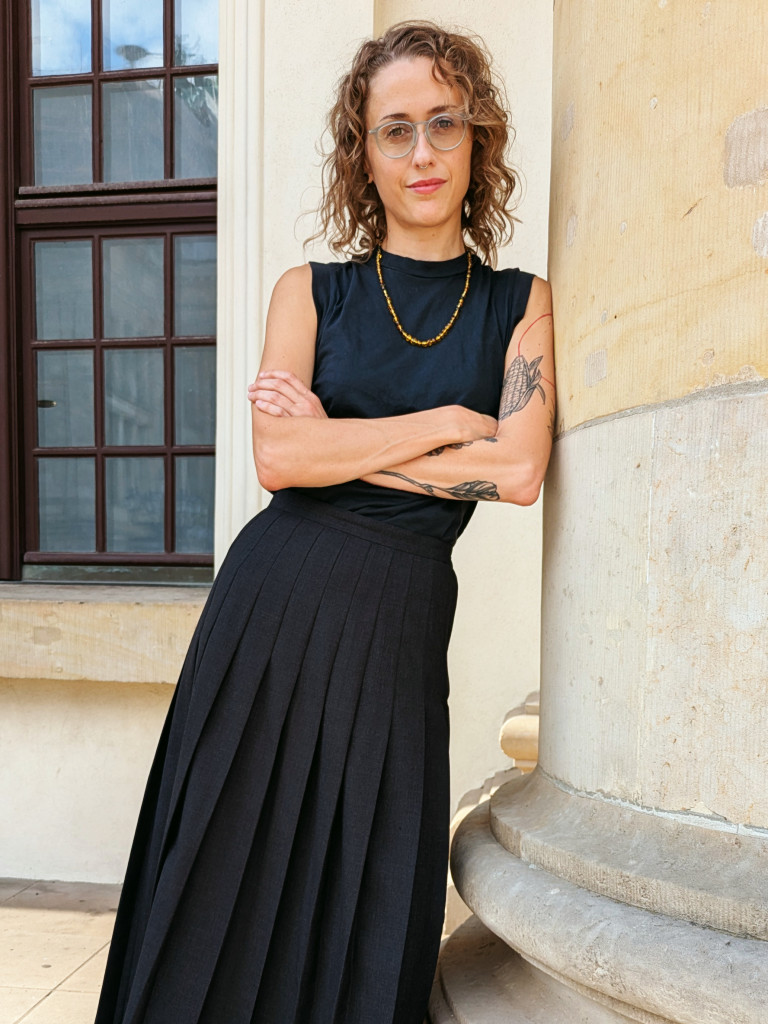
Anke Gruendel heads the inter and transdisciplinary Transformation Lab at Leuphana University of Lüneburg. She holds a PhD in Politics from the New School for Social Research. Together with Charles Landry, she co-chairs the research network Organization in Uncertain Worlds. In recent publications, including a Special Issue on The Design Turn and a history on the emergence of public design, she explores how in twentieth- and twenty-first-century democracies design has become a focal point for critical inquiry into governance. A practically minded scholar, Anke is dedicated to translating academic insights into concrete political transformation.
ABOUT THE CREATIVE BUREAUCRACY FESTIVAL
Public administration, too, has excellent, creative solutions for almost every challenge facing society — the Creative Bureaucracy Festival brings them to the stage and the people behind them into conversation. The festival, in the words of its President Charles Landry, stands for the shift from a "No, because" culture to a "Yes, if" culture that embraces new ideas with enthusiasm. Through the presentation of the Creative Bureaucracy Awards, the festival also aims to strengthen the public reputation of administration. The Global Forum of Public Service Leaders, which begins on the day before the festival, is the annual gathering of public sector leaders from around the world. The Young Bureaucrats Event addresses the next generation of creative talent in the public sector. More information can be found at https://creativebureaucracy.org/.